Executing Backdoor Roth IRA: 2026 IRS Caps & Pro-Rata Rule
Anúncios
High earners facing strict IRS earning thresholds do not have to miss out on tax-free growth and distributions in retirement. Executing a Backdoor Roth IRA remains the premier legal strategy for high-income taxpayers to circumvent annual income limits and build long-term wealth.
This tax-advantaged conversion strategy works by funding a non-deductible traditional account before executing a prompt transfer into a post-tax retirement vehicle.
However, investors must navigate aggregation guidelines carefully, as existing pre-tax balances in Traditional, SEP, or SIMPLE accounts can trigger unexpected tax liabilities under IRS calculation formulas.
By timing your non-deductible contributions and zeroing out pre-existing tax-deferred balances, you can secure tax-free compounding without costly penalties. Here is how to execute this advanced retirement funding tactic cleanly while remaining fully compliant with current Treasury regulations.
Understanding the Backdoor Roth IRA Mechanism
The Backdoor Roth IRA strategy allows individuals whose income exceeds the direct Roth IRA contribution limits to indirectly fund a Roth account. This involves making a non-deductible contribution to a traditional IRA and then converting it to a Roth IRA. The process is entirely legal and has been affirmed by the IRS.
Anúncios
This mechanism is particularly valuable for high-income earners who are otherwise locked out of direct Roth contributions. The primary benefit lies in the tax-free growth and withdrawals in retirement, which can significantly enhance long-term financial security. Careful execution is essential to avoid common pitfalls.
The core principle behind Executing the Backdoor Roth IRA is to ensure that the traditional IRA funds being converted have no pre-tax basis. This is where the pro-rata rule becomes a critical consideration, demanding meticulous planning and understanding.
2026 IRS Income Caps: What to Anticipate
While the definitive 2026 IRS income caps for Roth IRA contributions have not yet been released, they are projected to increase based on inflation adjustments. For 2024, the income phase-out for Roth IRA contributions begins at $161,000 for single filers and $240,000 for married couples filing jointly. These figures serve as a baseline for future estimates.
Financial experts widely anticipate a modest increase in these thresholds for 2026, reflecting ongoing inflationary trends. This means that more individuals might find themselves above the direct contribution limits, making the Backdoor Roth IRA strategy even more relevant. Staying updated on these projections is crucial for proactive planning.
These anticipated income caps directly influence eligibility for direct Roth contributions, thereby increasing the importance of understanding and Executing the Backdoor Roth IRA. The strategy provides a consistent path to Roth benefits regardless of how high one's income rises.
The Pro-Rata Rule: A Critical Consideration
The pro-rata rule is perhaps the most significant hurdle when Executing the Backdoor Roth IRA Strategy. This rule dictates that if you have any pre-tax money in any traditional, SEP, or SIMPLE IRA accounts, a portion of your Roth conversion will be taxable. It prevents individuals from selectively converting only their non-deductible contributions.
To avoid triggering the pro-rata rule, the ideal scenario is to have a zero balance in all traditional, SEP, and SIMPLE IRA accounts at the time of conversion. This ensures that 100% of the converted funds are considered after-tax contributions, thus incurring no additional tax liability. This 'clean slate' approach is key to a tax-free conversion.
Anúncios
Consolidating Pre-Tax IRA Funds
One common method to circumvent the pro-rata rule is to roll over any existing pre-tax IRA balances into an employer-sponsored retirement plan, such as a 401(k), if the plan allows. This effectively removes the pre-tax funds from the IRA ecosystem, leaving only the non-deductible contributions for conversion.
Identify all traditional, SEP, and SIMPLE IRA accounts.
Determine the pre-tax basis in each account.
Explore employer-sponsored plan rollover options.
Strategic Timing of Conversions
The timing of your non-deductible contribution and subsequent Roth conversion is also critical. It is generally advisable to make the non-deductible contribution and convert it as quickly as possible, ideally within the same tax year. This minimizes any potential investment gains that could become taxable upon conversion.
Step-by-Step Guide to Executing the Backdoor Roth IRA Strategy
Executing the Backdoor Roth IRA Strategy involves a precise sequence of actions. Deviating from these steps can lead to unintended tax consequences. Adhering to this guide will help ensure a smooth and compliant process.
The first step is to ensure you do not have any existing pre-tax IRA balances that could trigger the pro-rata rule. If you do, address them before proceeding. This foundational step is often overlooked but is absolutely essential for a tax-efficient conversion.
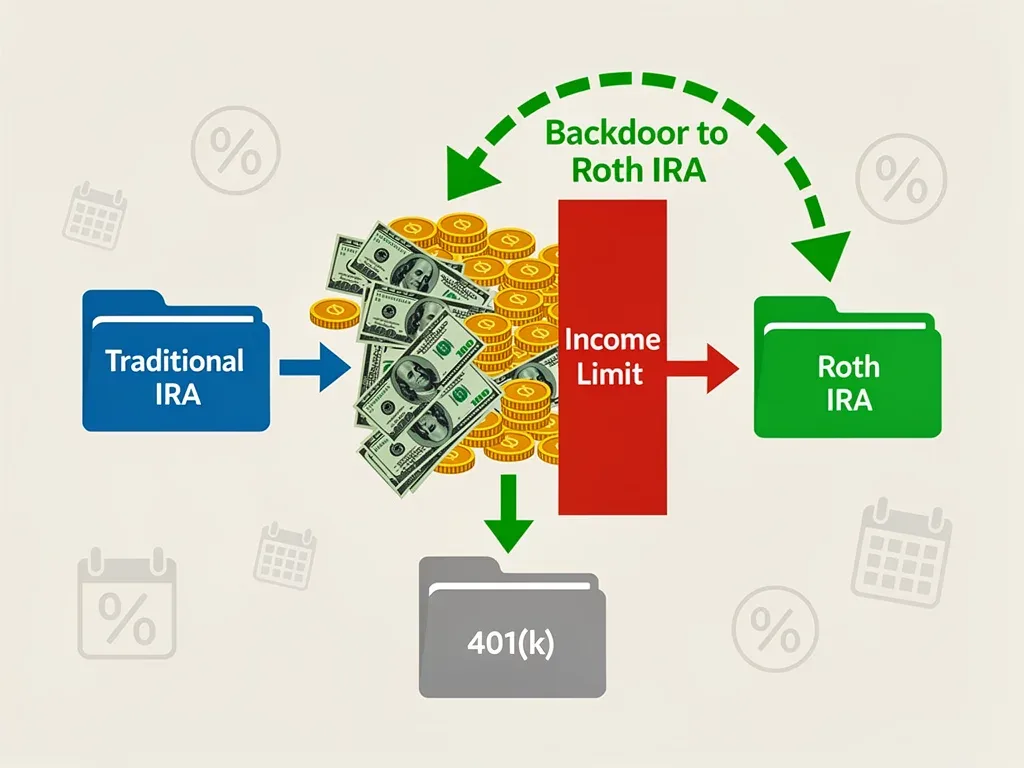
Once your traditional IRA accounts are clear of pre-tax funds, you can proceed with making a non-deductible contribution. This contribution will not reduce your taxable income for the year but is crucial for the subsequent conversion. The entire process hinges on these after-tax contributions.
Making Non-Deductible IRA Contributions
Contribute to a traditional IRA, ensuring you designate the contribution as non-deductible on IRS Form 8606. This form is vital for tracking your after-tax basis and proving to the IRS that the funds converted were not pre-tax. This documentation is non-negotiable.
Contribute the maximum allowable amount to a traditional IRA.
Ensure the contribution is explicitly designated as non-deductible.
File IRS Form 8606 accurately for the year of contribution.
Converting to a Roth IRA
Shortly after making the non-deductible contribution, initiate the conversion of these funds from your traditional IRA to a Roth IRA. This conversion is generally tax-free, provided you have no pre-tax IRA balances. The quicker this step is completed, the better.
Reporting Requirements: IRS Form 8606
Accurate reporting to the IRS is fundamental when Executing the Backdoor Roth IRA Strategy. IRS Form 8606, Nondeductible IRAs, is the cornerstone of this reporting. It tracks your non-deductible contributions and the subsequent conversions.
Failing to file Form 8606 correctly can lead to significant tax headaches, including double taxation on your converted funds. It's imperative to understand each section of the form and how it applies to your specific situation. This form acts as your proof of after-tax contributions.
For each year you perform a Backdoor Roth IRA, you must file Form 8606. It documents both the non-deductible contribution and the Roth conversion, clearly delineating the after-tax basis. This meticulous record-keeping safeguards against future IRS inquiries.
Common Pitfalls and How to Avoid Them
Despite its benefits, Executing the Backdoor Roth IRA Strategy is fraught with potential missteps. One of the most common errors is overlooking existing pre-tax IRA balances. This immediately triggers the pro-rata rule, making a portion of the conversion taxable.
Another frequent mistake is failing to properly document non-deductible contributions on IRS Form 8606. Without this form, the IRS may assume all IRA contributions were pre-tax, leading to a taxable conversion. Diligent record-keeping and accurate tax filing are non-negotiable.

Furthermore, some individuals make the non-deductible contribution but delay the conversion, allowing the funds to grow within the traditional IRA. Any gains realized before conversion will be taxable. Prompt conversion minimizes this risk and ensures a nearly tax-free process.
Mistake: Ignoring the Aggregation Rule
The IRS's aggregation rule means that all traditional, SEP, and SIMPLE IRAs are treated as one single IRA for pro-rata calculations. You cannot simply convert funds from one IRA while ignoring others. All accounts must be considered in aggregate.
Review all IRA accounts, not just the one being converted.
Ensure aggregate pre-tax balance is zero before conversion.
Consult a financial advisor for complex IRA structures.
Mistake: Incorrectly Filing Form 8606
Inaccurate or incomplete filing of Form 8606 can lead to significant tax issues. This form is your official record of after-tax contributions and conversions. Errors here can result in double taxation or penalties.
Benefits of a Backdoor Roth IRA in 2026
The primary benefit of Executing the Backdoor Roth IRA Strategy is gaining access to tax-free growth and withdrawals in retirement. This can be immensely valuable, especially for high-income earners who expect to be in a higher tax bracket in retirement or whose income already prevents direct Roth contributions.
Roth IRAs also offer flexibility, as contributions can be withdrawn tax-free and penalty-free at any time. This provides an emergency fund option that traditional retirement accounts do not. The ability to access contributions without penalty adds a layer of financial security.
Furthermore, Roth IRAs have no required minimum distributions (RMDs) for the original owner, offering greater control over retirement assets and facilitating estate planning. This allows funds to continue growing tax-free for longer, potentially benefiting heirs. These advantages make the strategy highly appealing.
Consulting a Financial Professional
Given the complexities of Executing the Backdoor Roth IRA Strategy, seeking advice from a qualified financial advisor or tax professional is highly recommended. They can help navigate the specific nuances of your financial situation, ensuring compliance and optimizing outcomes.
A professional can assist in reviewing all your IRA accounts, identifying potential pro-rata rule triggers, and guiding you through the accurate completion of IRS Form 8606. Their expertise can prevent costly mistakes and provide peace of mind. This is particularly true for those with multiple retirement accounts.
Moreover, a financial advisor can integrate the Backdoor Roth IRA strategy into your broader financial plan, considering other investment vehicles and tax strategies. Their comprehensive approach ensures that this tactic aligns with your overall retirement goals and risk tolerance. Professional guidance is an investment in your financial future.
Key Point | Brief Description |
|---|---|
Strategy Purpose | Allows high-income earners to contribute to Roth IRAs indirectly. |
Avoiding Pro-Rata | Ensure zero pre-tax IRA balances at conversion time. |
2026 Caps | Projected increase in IRS income limits for direct Roth contributions. |
Key Form | IRS Form 8606 is crucial for documenting non-deductible contributions. |
Frequently Asked Questions About Backdoor Roth IRAs
What is the primary benefit of a Backdoor Roth IRA?▼
The main benefit is enabling high-income earners, who exceed direct Roth IRA contribution limits, to still access the tax-free growth and tax-free withdrawals in retirement that Roth accounts provide. This strategy offers a significant advantage for long-term savings.
How does the pro-rata rule affect my conversion?▼
The pro-rata rule can make a portion of your Roth conversion taxable if you have existing pre-tax funds in any traditional, SEP, or SIMPLE IRA. It requires conversions to be proportional to your pre-tax and after-tax balances across all IRAs.
Are 2026 IRS income caps for Roth IRAs finalized?▼
No, the 2026 IRS income caps are not yet finalized. They are typically announced later in the year, with projections based on inflationary adjustments. Current 2024 caps provide a baseline for what to anticipate in 2026, which will likely see an increase.
What is IRS Form 8606 used for in this strategy?▼
IRS Form 8606, Nondeductible IRAs, is essential for reporting your non-deductible traditional IRA contributions and subsequent Roth conversions. It tracks your after-tax basis, preventing double taxation and proving compliance with IRS regulations.
Can I avoid the pro-rata rule if I have pre-tax IRA money?▼
Yes, you can often avoid the pro-rata rule by rolling over your pre-tax IRA funds into an employer-sponsored retirement plan, like a 401(k), if permitted. This clears your traditional IRA of pre-tax assets before you convert non-deductible contributions.
Looking Ahead: Ensuring Future Financial Security
The ability to continue Executing the Backdoor Roth IRA Strategy remains a cornerstone of savvy retirement planning for high-income individuals.
As IRS regulations evolve, staying informed and proactive is key to maximizing tax-advantaged savings. The strategic use of this mechanism ensures access to crucial Roth benefits, offering long-term financial stability.
Monitoring IRS announcements for the definitive 2026 income caps and contribution limits will be vital. Additionally, continuous review of personal financial circumstances and existing retirement accounts is essential to adapt the strategy as needed. The landscape of financial planning demands vigilance and informed decision-making.
Ultimately, successfully navigating the complexities of the Backdoor Roth IRA strategy under future IRS guidelines underscores the importance of professional financial advice. This ensures that every step taken is compliant, efficient, and aligned with your broader wealth-building objectives, securing a robust financial future.