Offsetting Capital Gains: Harvest Losses Up to $3,000
Anúncios
Turning portfolio underperformers into tax savings is one of the smartest moves you can make before year-end, especially when offsetting capital gains. Realizing losses on declining investments allows savvy investors to neutralize taxable market profits and lower their overall tax burden.
Beyond balancing out investment profits, federal tax rules permit deducting up to $3,000 of excess realized losses against ordinary income like salary or wages. Any remaining unused paper losses roll over indefinitely into future tax years, creating long-term strategic value from market downturns.
Mastering wash-sale constraints ensures you claim every available credit without triggering IRS penalties. Let's explore how tax-loss harvesting can minimize your annual tax bill and optimize your portfolio's net returns.
Understanding Capital Gains and Losses: The Basics
Capital gains and losses are fundamental concepts in investment and taxation. A capital gain occurs when you sell an asset, such as stocks, bonds, or real estate, for more than you paid for it. Conversely, a capital loss happens when you sell an asset for less than its original purchase price.
These gains and losses are categorized as either short-term or long-term, depending on how long you held the asset. Short-term gains and losses apply to assets held for one year or less, while long-term gains and losses are for assets held for more than one year. The distinction is crucial for tax purposes, as different tax rates apply.
Anúncios
The Internal Revenue Service (IRS) has specific rules governing how these gains and losses are treated on your tax return. Understanding these rules is the first step toward effectively managing your tax liability and leveraging strategies like offsetting capital gains.
The Power of Tax-Loss Harvesting for Offsetting Capital Gains
Tax-loss harvesting is a strategic practice employed by investors to minimize their tax liability. It involves selling investments at a loss to offset capital gains realized from other investments. This proactive approach can significantly reduce the amount of tax you owe on your investment profits.
The core idea behind tax-loss harvesting is to intentionally realize losses in your portfolio to balance out gains. This isn't about making poor investment decisions, but rather about strategically managing your portfolio's tax implications. When done correctly, it can free up capital that would otherwise go to taxes, allowing for further investment or other financial goals.
This strategy becomes particularly powerful when considering the ability to use these losses to reduce ordinary income, a key aspect of offsetting capital gains beyond just other investment profits. It's a year-round strategy, but often gains significant attention as tax season approaches.
How to Harvest Up to $3,000 in Losses Against Ordinary Income
One of the most appealing aspects of tax-loss harvesting is the ability to deduct a portion of your net capital losses against your ordinary income. The IRS allows taxpayers to deduct up to $3,000 of net capital losses against their ordinary income each year, which includes wages, salaries, and interest income.
This $3,000 limit applies to both single filers and those married filing jointly. If your net capital losses exceed this $3,000 limit in a given year, the remaining loss can be carried forward to future tax years. This carryforward provision means that unused losses don't expire and can continue to reduce your taxable income in subsequent years, providing long-term tax benefits.
To utilize this deduction, you must first net your capital gains and losses. If your total capital losses exceed your total capital gains, you have a net capital loss.
Anúncios
This net loss can then be applied against your ordinary income, up to the $3,000 annual maximum, making it a critical tool for offsetting capital gains and reducing overall tax burden.
Navigating the Wash-Sale Rule: A Critical Consideration
When engaging in tax-loss harvesting, investors must be acutely aware of the wash-sale rule. This IRS rule prevents taxpayers from claiming a loss on the sale of stock or securities if they buy substantially identical stock or securities within 30 days before or after the sale.
The wash-sale period, therefore, spans 61 days (30 days before the sale, the day of the sale, and 30 days after the sale).
The purpose of the wash-sale rule is to prevent investors from artificially creating tax losses without actually changing their investment position. If a wash sale occurs, the loss is disallowed, and instead, it is added to the cost basis of the newly purchased shares. This defers the tax benefit rather than eliminating it entirely, but it prevents immediate tax savings.
Understanding and adhering to the wash-sale rule is paramount for effective tax-loss harvesting. Investors often need to carefully plan their trades to avoid triggering this rule, ensuring that their efforts in offsetting capital gains are legitimate and recognized by the IRS.
Strategic Timing for Maximizing Tax-Loss Harvesting Benefits
Timing is a critical element in maximizing the benefits of tax-loss harvesting. While losses can be realized throughout the year, many investors focus on this strategy towards the end of the calendar year, often in November and December. This allows them to assess their overall gains and losses for the year and make final adjustments before the tax year closes.
However, waiting until the last minute can be risky. Market conditions can change rapidly, and a planned sale might not yield the expected loss if the market rebounds. Therefore, a more consistent approach, reviewing portfolios periodically throughout the year, can be more effective. This allows for more flexibility and responsiveness to market movements.
Investors should also consider the impact of short-term versus long-term capital gains and losses. Short-term losses are generally more valuable as they can offset short-term gains, which are taxed at higher ordinary income rates. Strategic timing ensures that you are effectively offsetting capital gains in the most tax-efficient manner possible.
Real-World Scenarios: Applying Loss Harvesting
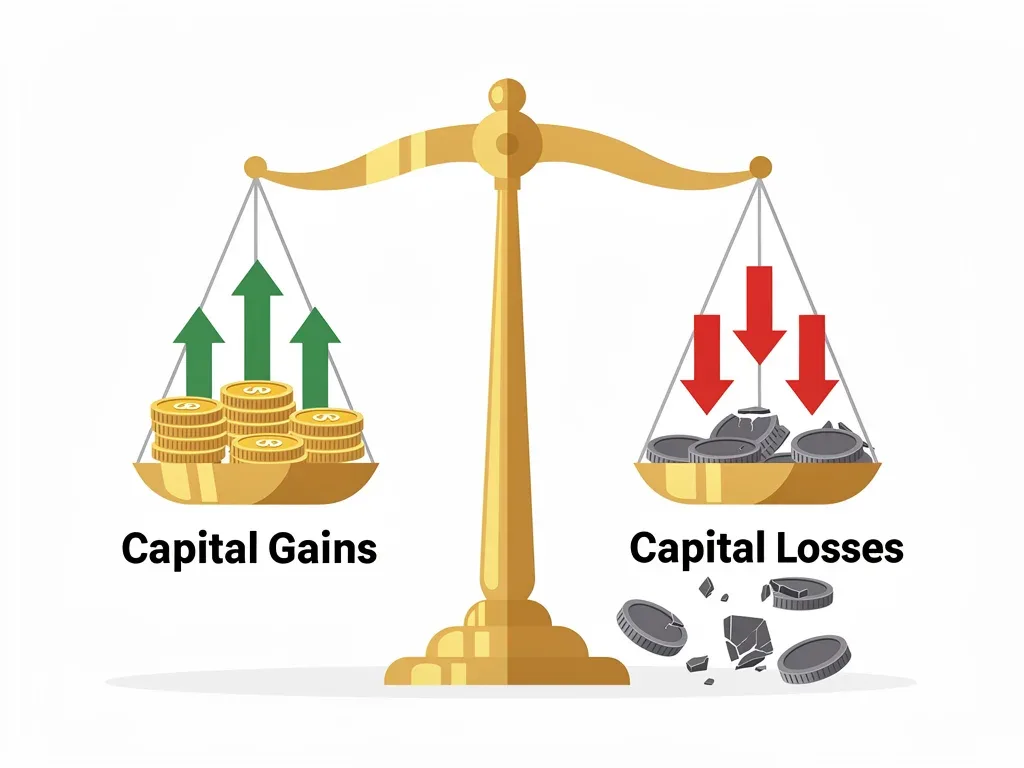
Consider an investor who realized $10,000 in capital gains from selling a profitable stock during the year. Simultaneously, another stock in their portfolio has declined significantly, showing a $15,000 unrealized loss. By selling the losing stock, the investor realizes a $15,000 capital loss.
This $15,000 loss first offsets the $10,000 capital gain, resulting in a net capital loss of $5,000. Under current IRS rules, the investor can then deduct $3,000 of this net capital loss against their ordinary income, reducing their taxable income by that amount. The remaining $2,000 loss can be carried forward to the next tax year.
In another scenario, an investor might have only $1,000 in capital gains but $5,000 in capital losses. After netting these, they have a $4,000 net capital loss. They can still deduct $3,000 against ordinary income, carrying forward $1,000. These examples highlight the practical benefits of offsetting capital gains through strategic loss harvesting.
Beyond $3,000: Carrying Forward Unused Capital Losses
As discussed, any net capital loss exceeding the $3,000 annual deduction limit can be carried forward to subsequent tax years. This carryforward provision is a significant advantage for investors, as it provides a multi-year tax benefit. The carried-over losses retain their character as either short-term or long-term losses, which can be important for future tax calculations.
For instance, if you have a $10,000 net capital loss in one year, you can deduct $3,000 against ordinary income, leaving $7,000 to carry forward. In the following year, if you realize $5,000 in capital gains, you can use $5,000 of your carried-forward loss to offset those gains entirely.
You would then have $2,000 remaining to carry forward to the next year, plus the ability to deduct another $3,000 against ordinary income if you have no further gains.
This perpetual nature of capital loss carryforwards means that even substantial losses incurred in a single year can provide tax relief for many years to come. It underscores the long-term strategic value of diligently tracking and utilizing capital losses when offsetting capital gains.
Professional Guidance and Software Tools for Tax Planning
While the principles of tax-loss harvesting and offsetting capital gains are straightforward, the actual implementation can be complex, especially for investors with diverse portfolios or numerous transactions.
This is where professional guidance becomes invaluable. Financial advisors and tax professionals can provide personalized strategies, ensure compliance with IRS rules, and help optimize tax outcomes.
In addition to professional advice, various software tools and online platforms are available to assist investors. Many brokerage firms offer robust reporting features that track gains and losses, making it easier to identify opportunities for tax-loss harvesting.
Specialized tax software can also help calculate net gains and losses, apply carryforwards, and ensure accurate reporting on tax returns.
Utilizing a combination of expert advice and technological tools can significantly streamline the process, reduce the risk of errors, and enhance the overall effectiveness of your tax planning efforts. This integrated approach helps investors confidently navigate the complexities of investment taxation.
Key Point | Brief Description |
|---|---|
Tax-Loss Harvesting | Selling investments at a loss to offset capital gains and potentially ordinary income. |
$3,000 Ordinary Income Limit | Maximum net capital loss deductible against ordinary income annually. |
Wash-Sale Rule | Prevents claiming a loss if substantially identical securities are repurchased within 30 days. |
Loss Carryforward | Unused capital losses can be carried forward to offset future gains and income. |
Frequently Asked Questions About Offsetting Capital Gains
What is the primary benefit of offsetting capital gains?▼
The primary benefit is reducing your overall tax liability. By using investment losses to offset gains, you pay less in capital gains tax. Additionally, you can deduct up to $3,000 of net losses against your ordinary income, which can further lower your taxable income and save you money on your annual tax bill.
Does the $3,000 limit for offsetting ordinary income apply per person or per household?▼
The $3,000 limit applies per taxpayer. For married couples filing jointly, the limit remains $3,000 for the combined return. This means a joint return cannot deduct $6,000 ($3,000 for each spouse) against ordinary income; the maximum combined deduction is $3,000, regardless of individual losses.
How long can I carry forward unused capital losses?▼
Unused capital losses can be carried forward indefinitely. There is no time limit for how long you can use these losses to offset future capital gains or deduct against ordinary income, subject to the annual $3,000 limit. This provides a valuable, long-term tax planning tool for investors.
Can I harvest losses from any type of investment?▼
Generally, you can harvest losses from most types of taxable investments, including stocks, bonds, mutual funds, ETFs, and real estate. However, losses from personal-use assets (like your primary residence) or investments held in tax-advantaged accounts (like IRAs or 401(k)s) typically cannot be used for tax-loss harvesting.
What happens if I trigger the wash-sale rule?▼
If you trigger the wash-sale rule, the loss you realized on the sale of the security is disallowed for tax purposes. Instead, the disallowed loss is added to the cost basis of the substantially identical security you purchased. This defers the loss rather than eliminating it, meaning you'll realize the benefit when you eventually sell the new shares.
Looking Ahead: Optimizing Your Tax Strategy
The ability to effectively manage capital gains and losses, particularly through strategies like offsetting capital gains by harvesting up to $3,000 in losses against ordinary income, remains a crucial component of sound financial planning.
As tax seasons evolve, staying informed about IRS regulations and market dynamics is paramount. Investors should consider regular portfolio reviews and, when necessary, seek professional advice to ensure they are fully leveraging available tax benefits.
The ongoing goal is to minimize tax liabilities while optimizing investment returns, a balance that requires continuous attention and strategic action.